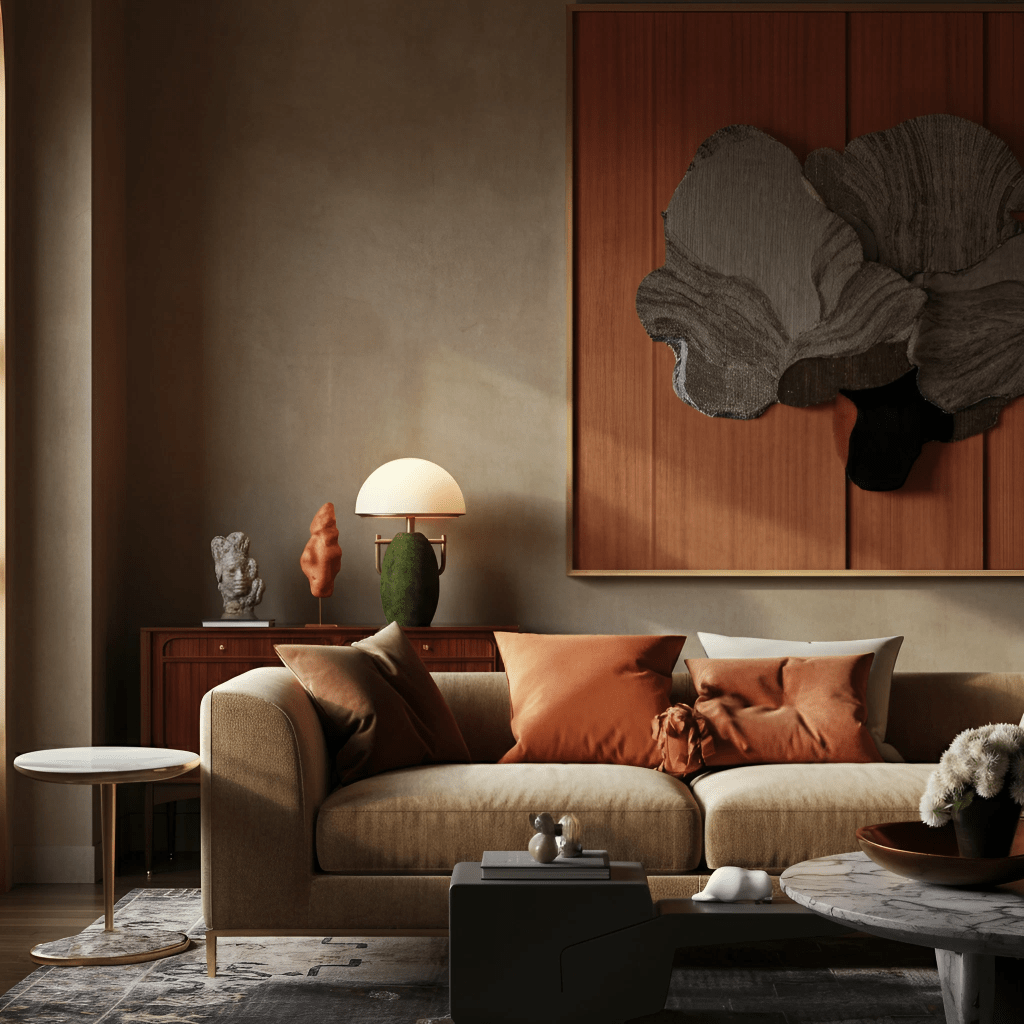
This post is a summation and analysis for the popular interior design book by Frida Ramstedt, “The Interior Design Handbook”. This post references Chapter 2: Basic Principles and Rules of Thumb.
The Golden Ratio
The Golden Ratio can be described as a line divided into a longer part, a, and a shorter part, b, so that a + b is to a, as a is to b.
The Rule of Thirds
Provides a simplified approximation of the proporitions of the golden ratio.
Don’t center objects, better to keep the object(s) of focus where the gridlines meet
Triangles & Three-Point Thinking
Position objects in a way that their outlne forms a triangle, can be used for equilateral and right triangles.
The Optical Midpoint
Generally it is not a best practices to geometrically center an object in design. The optical center lies about 10% above the geometric center.
Focal Points
What do you want to center? What do you want to tone down?
Tricks with Lines
Lines can be used in an optimcal illusion to make a space look different (ex. wider, longer, more narrow). Can be used in furniture, wall paper, and flooring.
- Leading Lines-The use of lines to lead te eye to the place or the object they want to focus on
- Diagnol Lines-Lines that emerge at an agle from the triangular concept and lead the eye oblique;y upward or downward
- Horizontal Lines– came make a room feel wider, paneling can make a room feel more intimate
- Vertical Lines– draw the eye upward, making the height of the ceiling seem taller than it really is
- Curved Lines– Keep a room from feeling too “sharp”. Can be done by adding circular rugs, or arched furniture and mirrors
- Lines on the Floor– Lines can be found in parquet flooring, earthenware tiles, wooden tiles, etc.
Visual Weight
Visual weight refers to how heavy a room appears to be. Factors that can make a room look more heavy can include…
- larger objects
- darker colors
- strong contrasts
- warm shades
- objects in corners or on the edge
- diagonal lines
- complex shapes
Factors in a room that can make it look for “light” can include…
- smaller objects
- light colors
- mild contrast
- cold shades
- objects closer to the center
- horizontal lines
- simple shapes
Visual weight can be great for emphasizing a focal point or drawing the eye to a specific area.
Anchoring
Anchoring refers to the concept of adding a visual center of gravity to each room (note this is not the same as a focal point). It should function to create a calm weight so the viewer’s attention can move to the intended area. An example would be adding a rug to a large room with many visual elements to link the furniture together.
 Learning Interior Design
Leave a comment